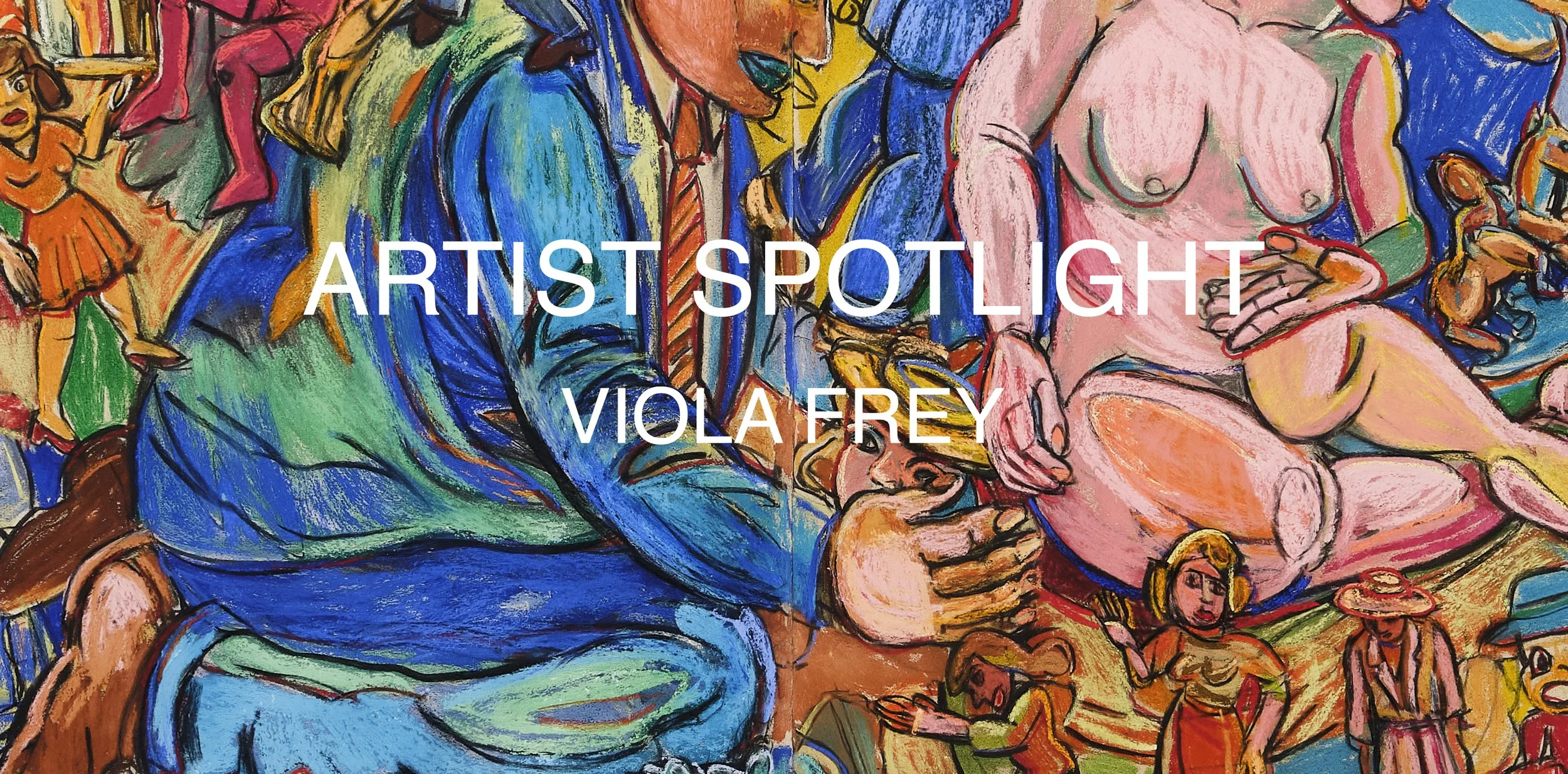
The interdisciplinary artist Viola Frey (1933–2004), was a prolific creator who produced thousands of artworks during her lifetime. While best known for her ceramic monumental sculptures, Frey’s artmaking spanned more than 40 years and encompassed paintings, drawings, and bronze and glass sculptures. Frey was obsessively devoted to her practice and produced thousands of artworks during her lifetime. Her work explores social constructs, marks of civilization, and gender dynamics, and features a thoughtfully built iconography including suited men, hands, and cast figurines. Her work in clay was ahead of its time, bridging the gap between craft and fine art, while pushing the boundaries of ceramic sculpture.
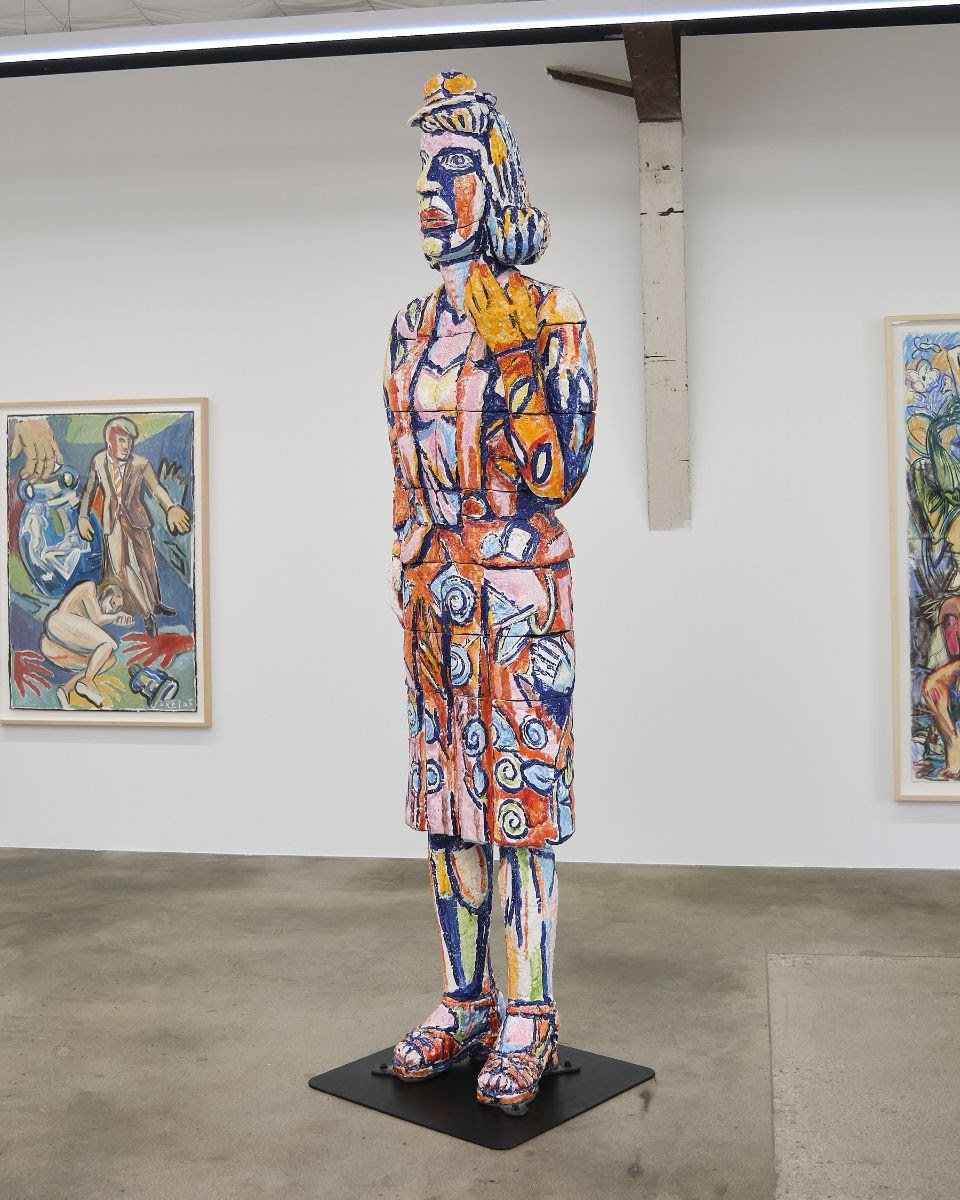
Viola Frey Largest Grandmother, 1987, Ceramic and glazes, 121 x 33 x 24 in. Photography by Chris Hanke.
“The duplication of duplicates of duplicates through ages, carried from one side of the world to the other and back again has kept ancient images familiar and therefore still at work as contemporary symbols.” -- Viola Frey, 1977
Frey helped push West Coast ceramics out of the realm of craft and into fine art, becoming one of the defining figures of that shift. She studied at California College of Arts and Crafts with Richard Diebenkorn, briefly on the painting faculty, along with Vernon "Corky" Coykendall, who taught wheel-throwing, and Charles Fiske, who taught hand-building, then went on to Tulane University for graduate school, studying painting with Mark Rothko and ceramic sculpture with Katherine Choy. A stint in New York during the height of Abstract Expressionism convinced her the city's gallery world had little use for clay, figuration, or women artists, and she returned to the Bay Area for good in 1960. She became known for ceramic figures that regularly exceed human scale, addressing identity, power, and the weight of accumulated material culture.
IN THE STUDIO
“Figurines function in order to make acceptable those things that our culture finds unacceptable. They might deal with old age, with menace, or with women. My work is figurative, but it’s as far towards the abstract transformation as it is possible to go and still retain the integrity of the image or the information.” -- Viola Frey, 1981
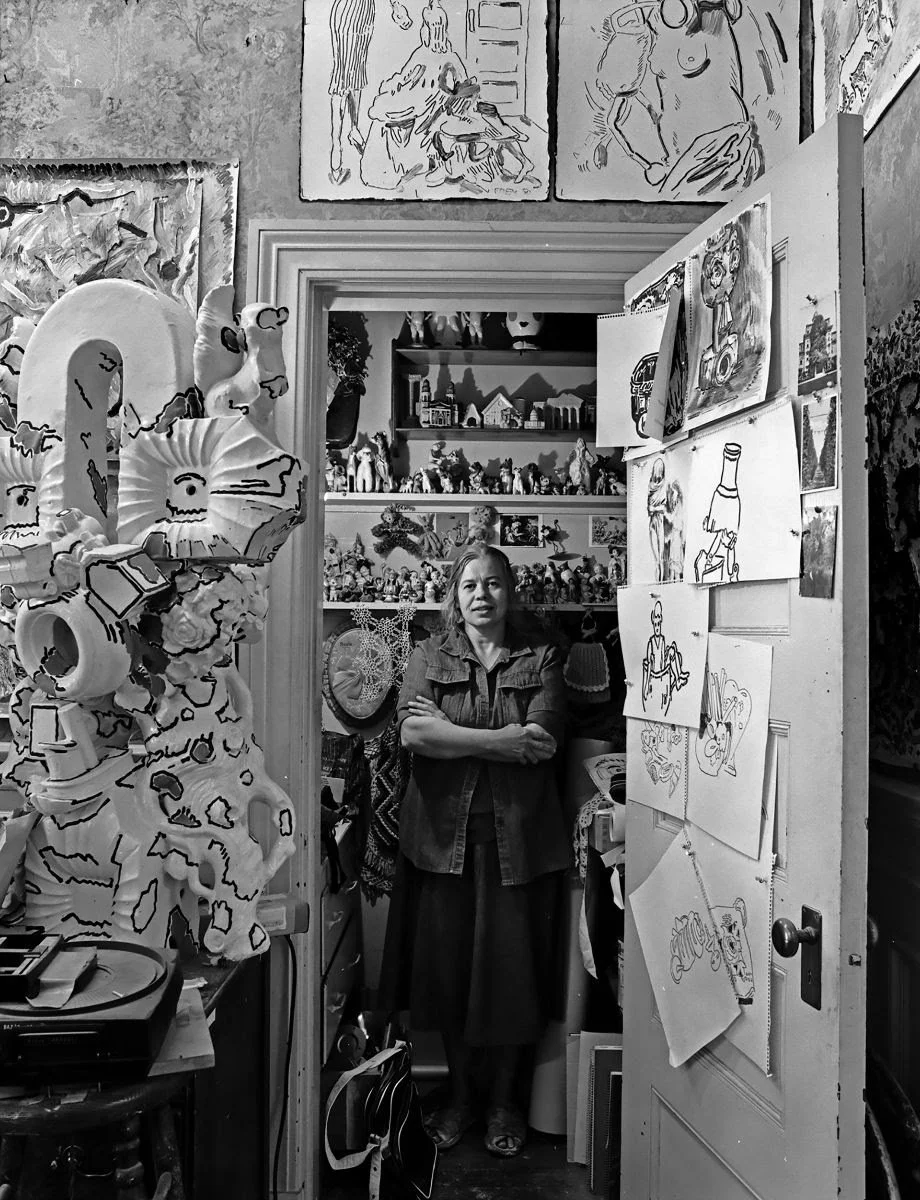
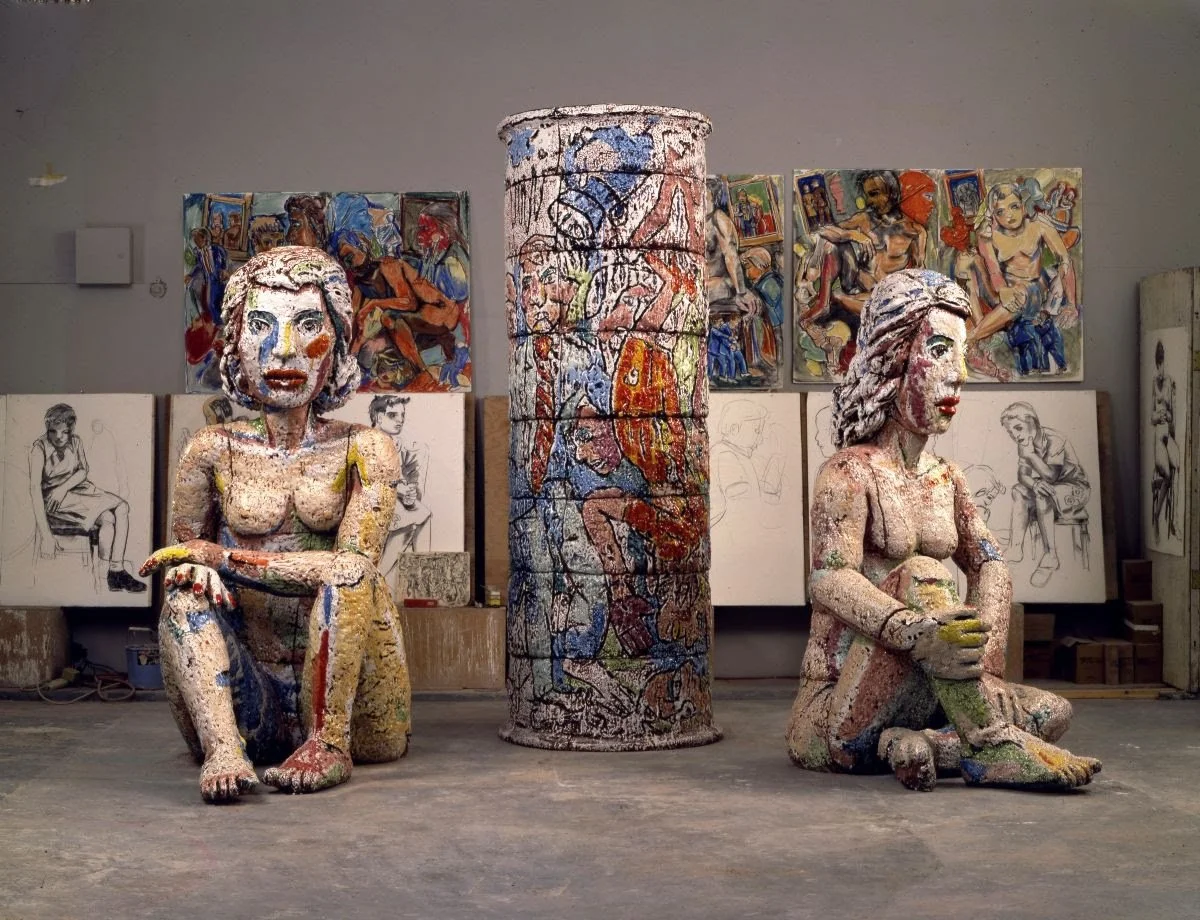
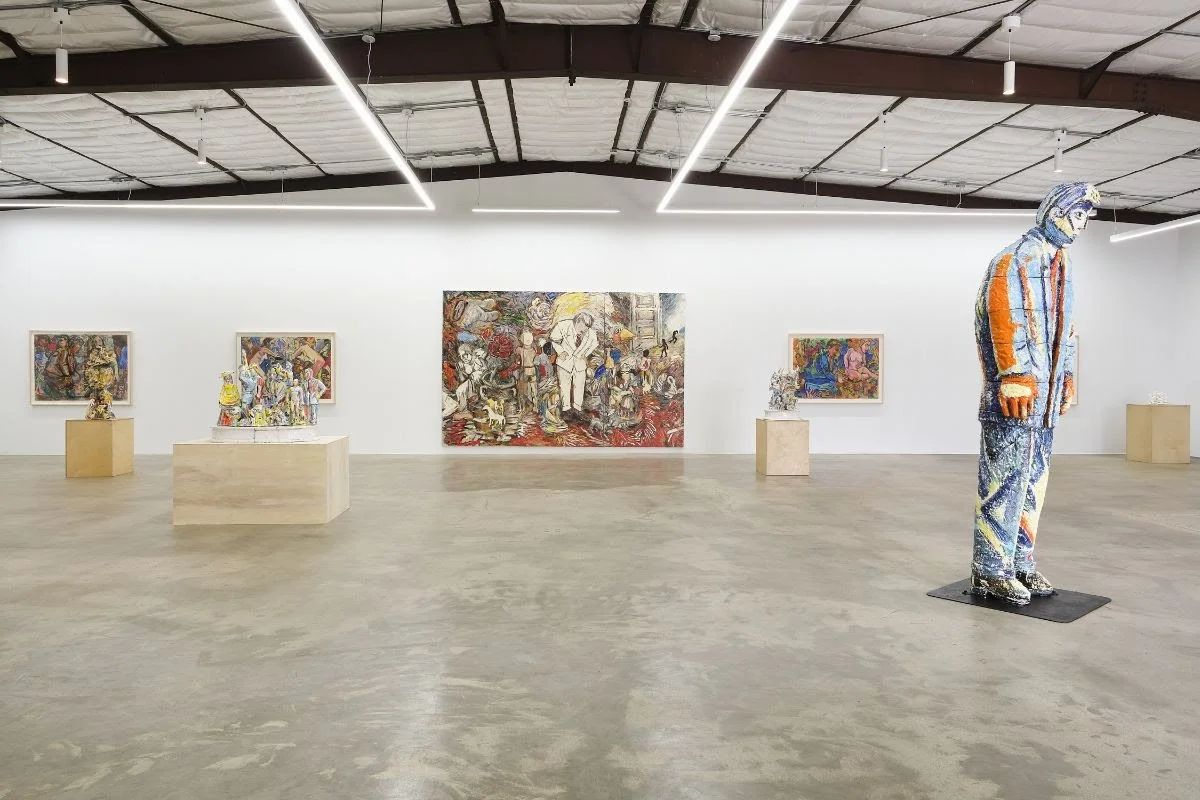
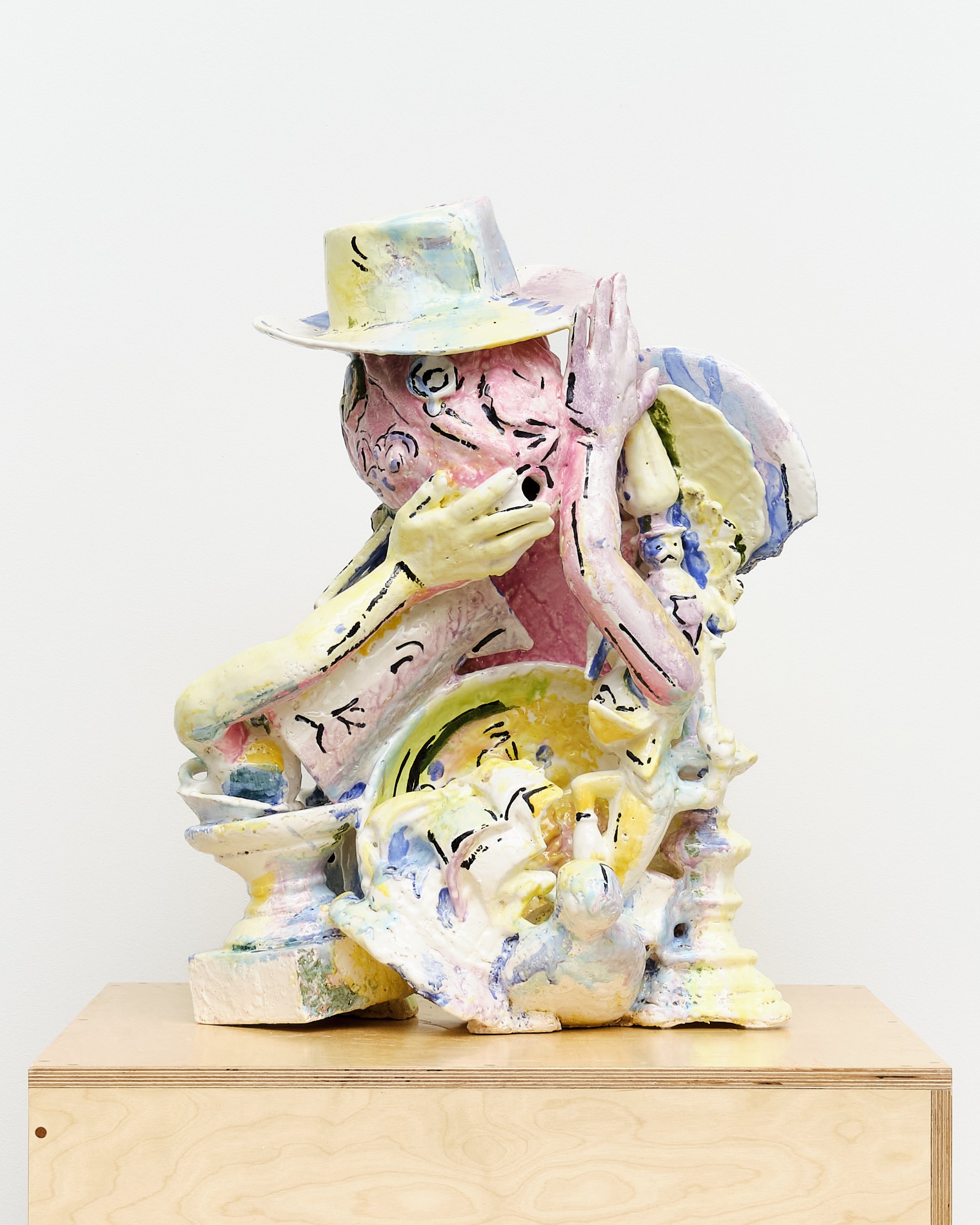
Frey's studio setup grew directly out of her house: she combined the living room and dining room into one large space for painting and drawing, kept a separate ceramics studio next to it, and used the yard behind the property to store materials and stage large-scale sculpture. As her sculpture grew larger, she moved into bigger warehouse studio space nearby, expanding again in 1983 and 1996. Rather than throwing on a wheel, she often worked in slabs, rolling clay flat and pressing sheets together by hand, the method behind an early 1965 wall-hung female figure built from two pushed-together slabs. She also treated breakage as material rather than failure, keeping pieces that cracked or fell apart in the kiln and reassembling them into new work instead of starting over, an approach behind her 1992 wall piece "The Decline and Fall of Western Civilization," built from studio cast-offs and roughly 20 feet across. Her glazes were left loose in the firing rather than tightly controlled, and her surfaces typically show visible fingerprints and tool marks rather than a smooth finish, setting her work apart from production pottery.
WORKS ON PAPER
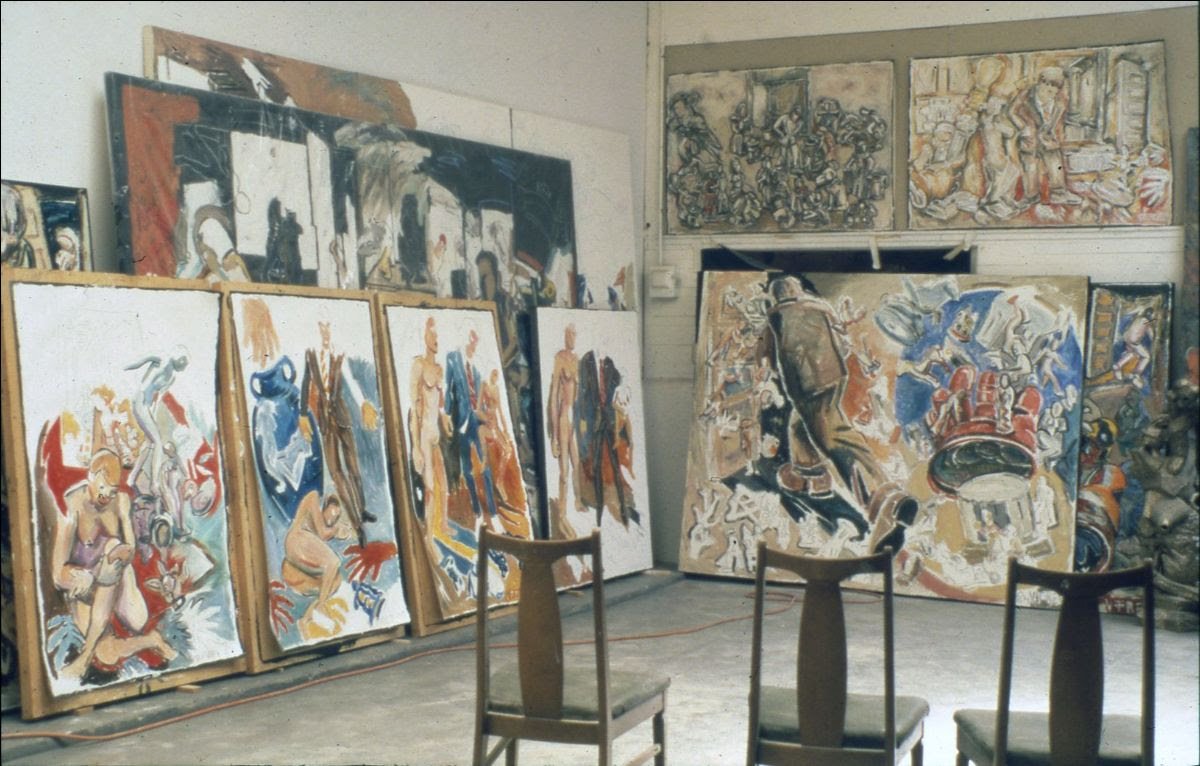
1984_c Third street with paintings on paper.
“Ceramics, drawing, sculpture form total means of expression. Fifteen years of constant involvement in these apparently separate fields of art have proven to me they are all closely related, in every case have like elements and each field of creative activity – ceramics, painting – enhances the other." -- Viola Frey, 1975
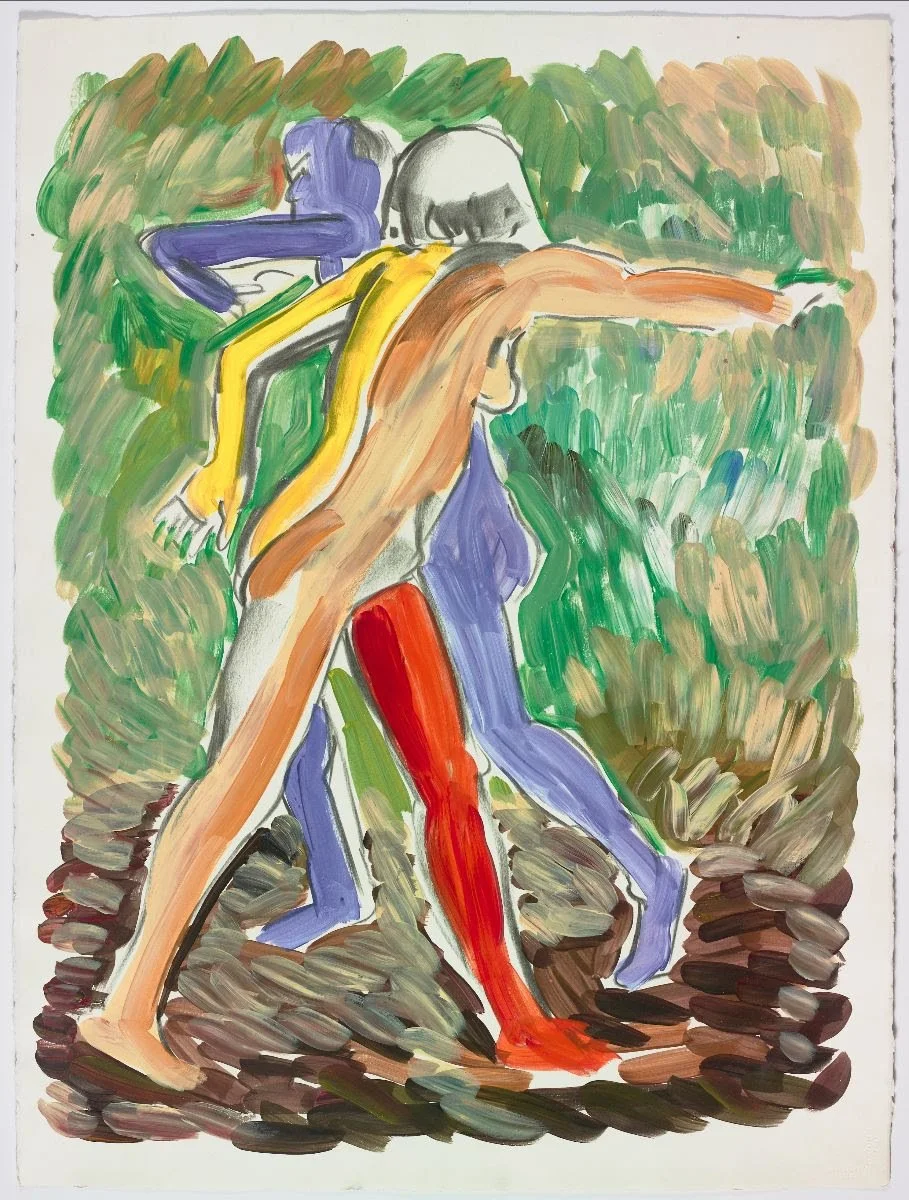
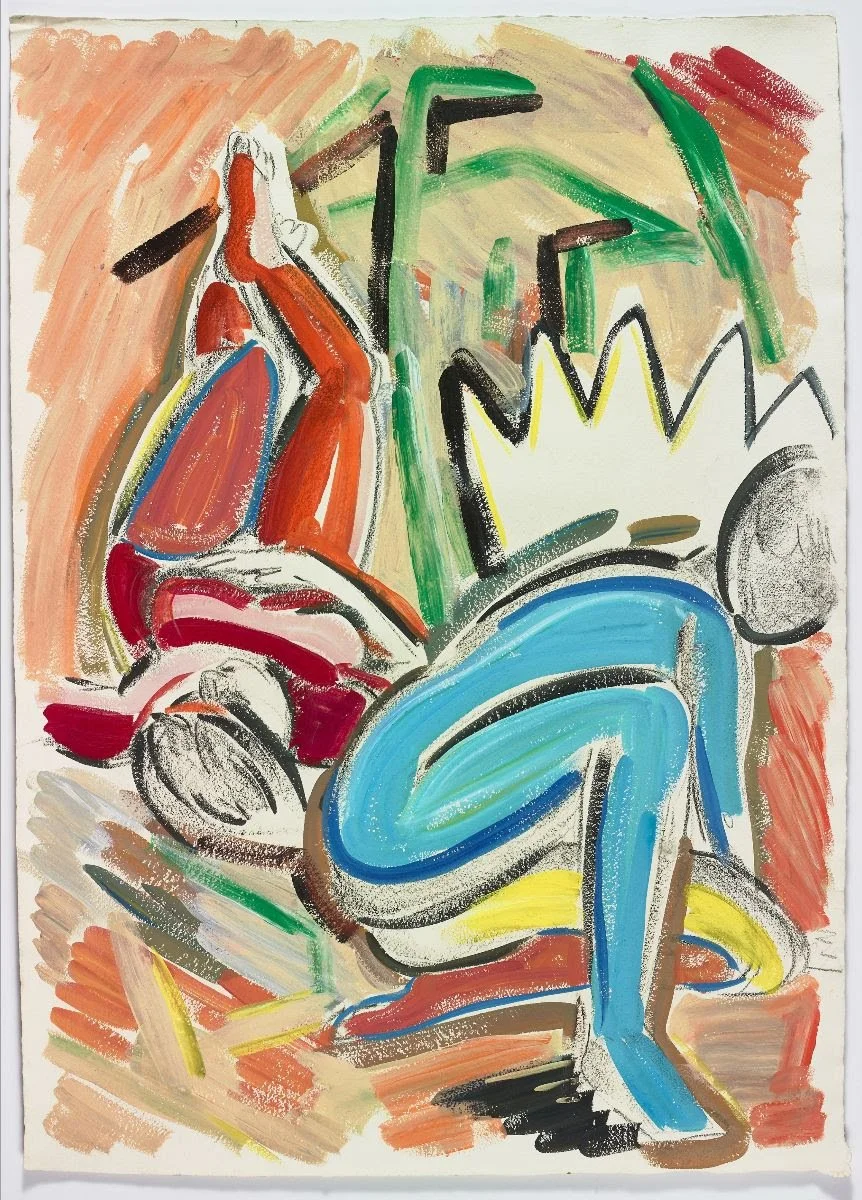
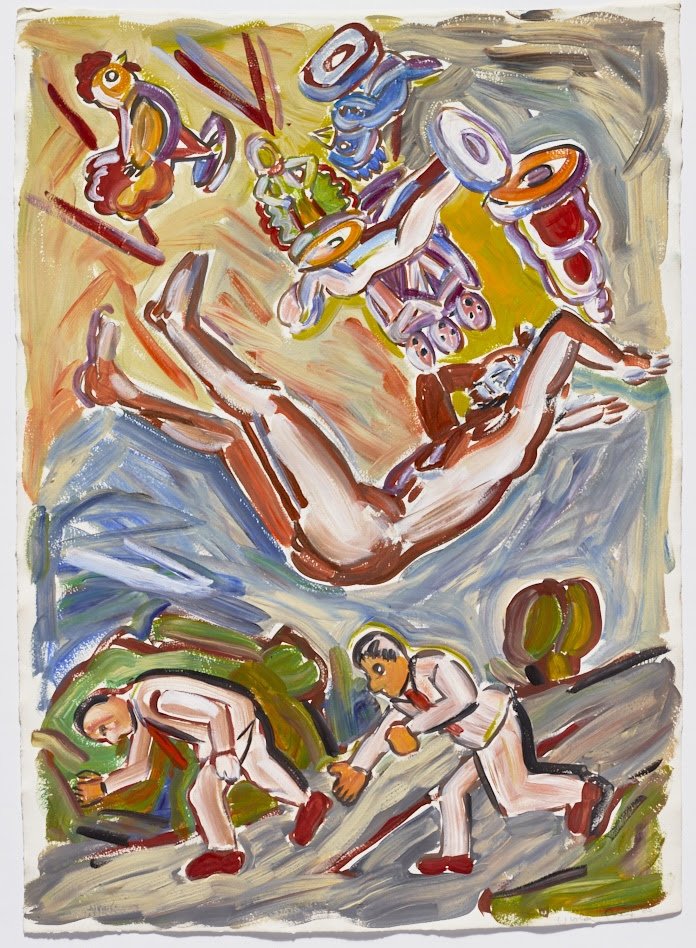
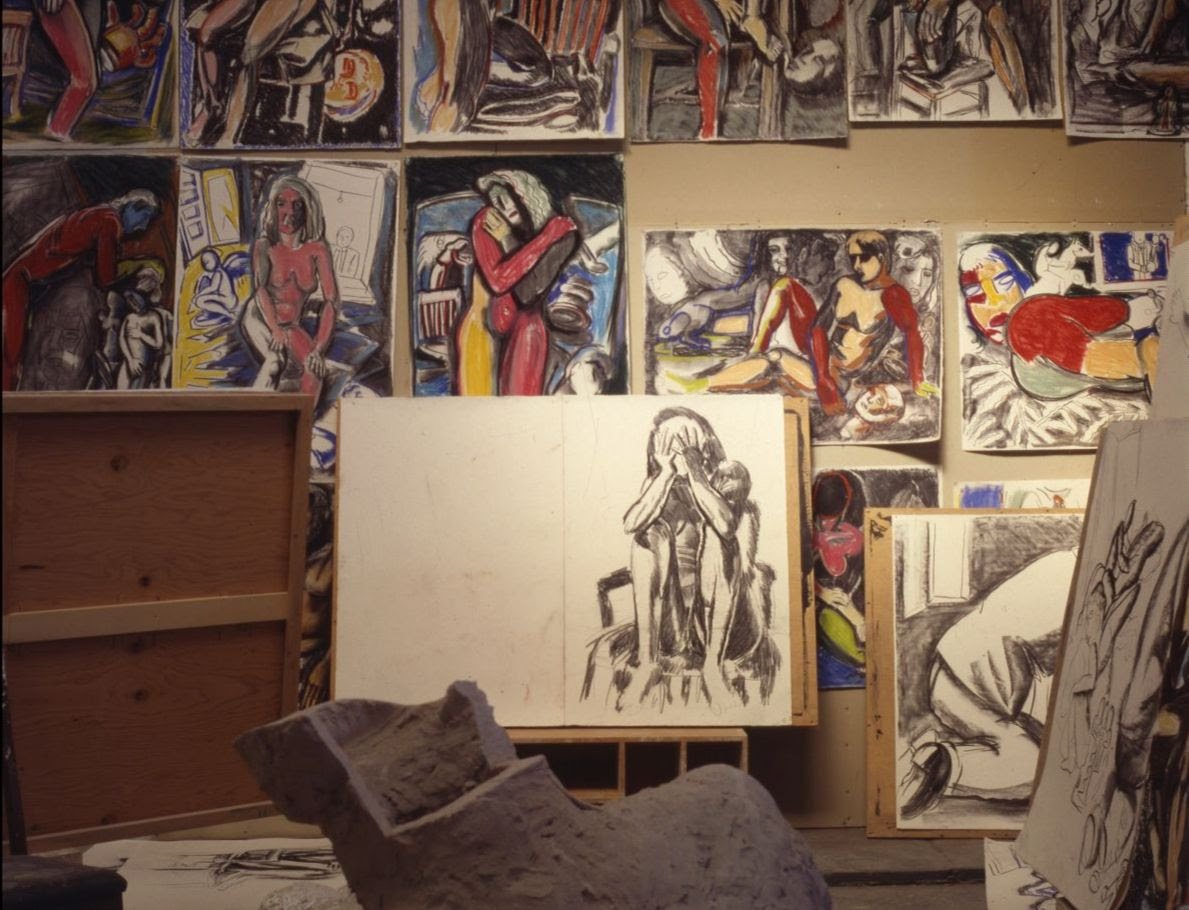
Frey trained as a painter before she trained as a ceramicist, and drawing and painting stayed active throughout her career, working less as preparatory sketches and more as a parallel practice where she tested the gestures and figures that later surfaced in clay. A group of works on paper from 1984 and 1985, held in the Artists' Legacy Foundation archive, makes that case directly. "Untitled (Two Men Running and Falling Figures)" (1985), worked in acrylic alone, catches two figures mid-tumble. "Untitled (Blue Figure and Reclining Orange Nude with Legs Raised)" (1984-1985) sets a standing blue figure against a reclining orange nude, both built up in acrylic and charcoal. "Untitled (Striding Nudes)" (1985) puts moving figures against a charcoal ground. All three run close to 30 by 22 inches, and all three center on the body caught off balance: running, falling, striding, reclining. That off-center physicality shows up again in her large-scale ceramic work from the same years, like the towering "Leaning Man III" (1984-85), which holds its own precarious, leaning stance in three dimensions instead of two.
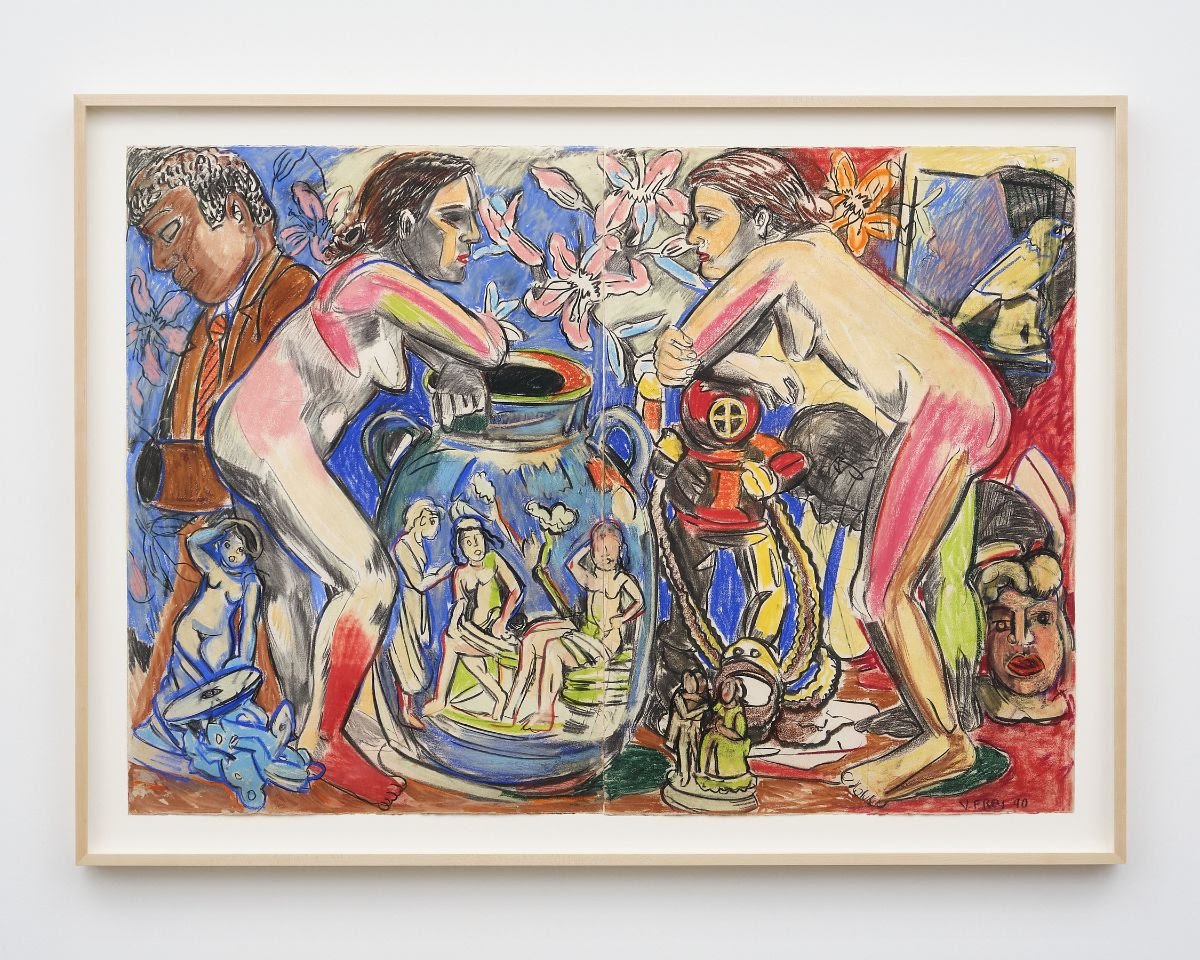
Viola Frey Artist Mind/Studio Diptych VIII, 1990, Pastel on paper. 42 x 59 in. Photography by Chris Hanke.
It was around this same period, the late 1980s and early 1990s, that Frey began naming this recurring territory directly in her titles, calling a body of drawings "Artist's Mind/Studio/World," the same three concerns that would later frame the retrospective monograph on her career. Seen together, these sheets read less like sketches and more like the place where she worked out, at a fraction of the scale, both the postures and the ideas her larger work would go on to carry.
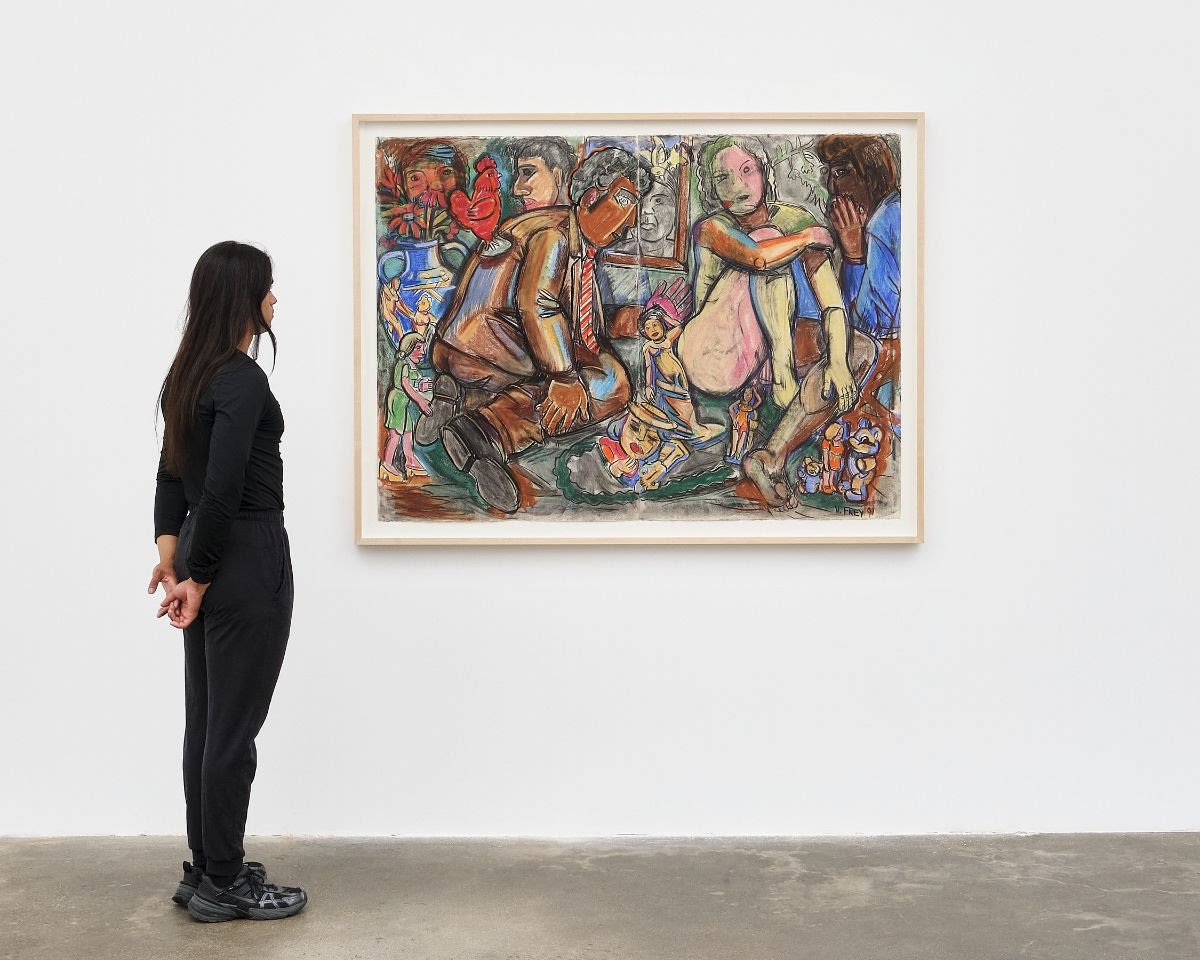
Viola Frey Artist Studio Series, Diptych #1, 1991, Pastel on paper, 44 x 60. in Photography by Chris Hanke.
Viola Frey received her BFA and honorary doctorate from California College of the Arts and Crafts in 1953 and attended graduate school at Tulane University. She taught at California College of Arts and Crafts (now CCA) for over three decades, influencing generations of young artists and formalizing the use of clay as an artistic medium. Her work is held in the collections of SFMOMA, the Oakland Museum of California, the di Rosa Center for Contemporary Art, the Whitney Museum of American Art, the Smithsonian American Art Museum, LACMA, and the Musée d'Art Moderne de Paris, and is on permanent public view at SFO's international terminal. In 2000, Frey co-founded the Artists' Legacy Foundation with Squeak Carnwath and Gary Knecht to support living artists and steward artists' estates, and the foundation has managed her archive and legacy since her death in 2004.
AVAILABLE WORKS